
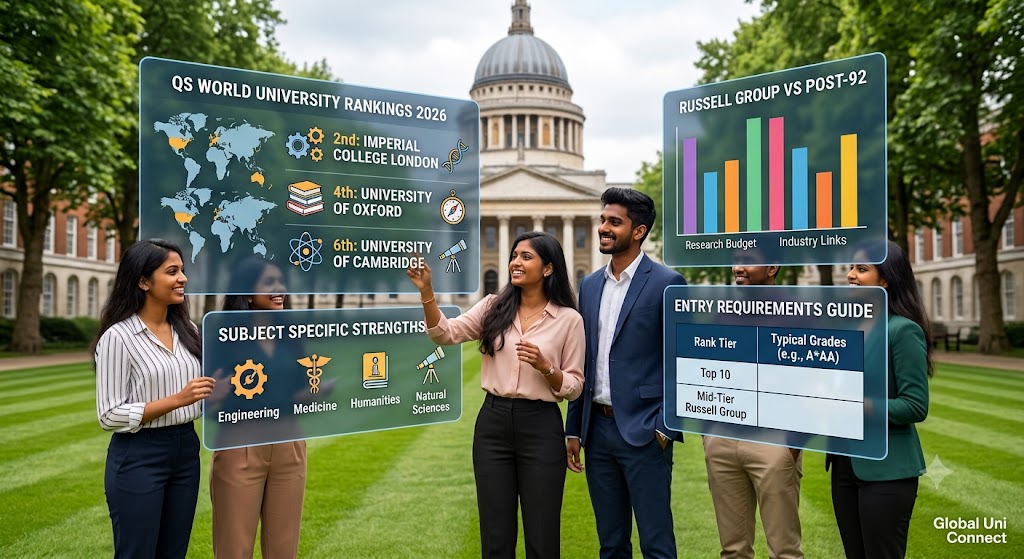
Where UK Universities Rank Globally in 2026
Curious where UK universities stand in 2026? This guide explores where UK universities rank globally in 2026, highlights the latest international rankings, and explains what they mean for students choosing the right university for their future.
Here’s where the leading Universities in UK sit:
| Rank | University | Known For |
| 2 | Imperial College London | Engineering, Medicine, STEM |
| 4 | University of Oxford | Humanities, Sciences, research breadth |
| 6 | University of Cambridge | Natural Sciences, research output |
| 9 | University College London | Architecture, Education, Medicine |
| 31 | King’s College London | Law, Health Sciences |
| 34 | University of Edinburgh | Life Sciences, Informatics |
| 35 | University of Manchester | Engineering, Business |
These figures are from QS 2026; Times Higher Education ranks.
Comparing QS, Times Higher Education, and UK League Tables
QS and THE both rank globally, weighting research output, academic reputation surveys, employer reputation, and international outlook heavily. Neither tells you much about actual teaching quality on a specific course.
UK domestic guides; the Complete University Guide, the Guardian University Guide, and the Times Good University Guide, rank differently: student satisfaction, entry grades, graduate prospects, and course-level teaching quality. For choosing between two similarly-ranked universities, these domestic tables are often more useful than a global position.
How Subject Rankings Help You Choose the Right UK University
A university’s overall position can hide huge variation by subject. Oxford ranks #1 globally for Accounting and Finance and Anatomy; Cambridge tops the world for Archaeology and English Literature; UCL is joint-first for Architecture and Pharmacy.
The reverse is also true: a university outside the global top 50 overall can rank in the world’s top 10 for one specific subject. Before you fixate on a university’s headline number, check the QS World University Ranking by Subject for your actual course, it’s usually the more relevant figure.
Russell Group vs Post-92 Universities
The Russell Group is a coalition of 24 research-intensive UK universities, including Oxford, Cambridge, Imperial, UCL, and Edinburgh. These typically carry higher entry requirements, larger research budgets, and stronger name recognition abroad.
Post-92 universities (former polytechnics, now full universities) often compete well on employability and industry-linked, practical courses, sometimes outperforming older institutions in specific fields like nursing, business, or media. They also tend to have lower entry requirements and more flexible admissions, worth considering depending on your grades, budget, and career goals.
Entry Requirements and English Scores by Ranking Tier
Requirements shift noticeably by tier. As a general guide:
| Tier | Typical Entry Grades | IELTS Academic |
| Top 10 (Oxbridge, Imperial, UCL) | A*AA–AAA | 7.0–7.5 |
| Mid-tier Russell Group | AAB–ABB | 6.5–7.0 |
| Post-92 / other universities | BBB–BCC | 6.0–6.5 |
Sri Lankan A/Level results are accepted across all tiers and assessed case-by-case, so always check the specific course page rather than relying on general bands.
Tuition Fees Across Ranking Tiers
Fees vary by both ranking tier and subject. Russell Group universities typically charge international students £20,000–£38,000 a year, with Medicine and specialist Engineering courses at the top end. Mid-tier and post-92 universities generally range £13,000–£18,000 a year for similar subjects.
Always verify current fees on the university’s own course page, they update annually and can shift significantly between intakes, especially for high-demand programs like Medicine or Data Science. Many universities also offer merit-based scholarships for international students, sometimes worth £2,000–£10,000 a year, so it’s worth checking eligibility even at higher-ranked institutions.
A Common Mistake: Ranking-Only Applications
Many Sri Lankan students apply only to universities in the QS top 50, then get rejected or waitlisted everywhere, because entry competition at that level is intense and doesn’t account for course fit. A strong application usually mixes ambition with realism: one or two reach schools, a few solid matches, and at least one safety option where your grades comfortably clear the entry bar.
How to Choose Your Target School: A Quick Checklist
- Check subject-specific rankings, not just the overall university position
- Compare entry requirements honestly against your predicted grades
- Look at graduate employment rates for your specific course, not the university average
- Factor in location and cost of living alongside tuition
- Check post-study work visa support and industry placement links
- Apply to a mix of reach, match, and safety schools, not just the highest-ranked option
Choosing a target school isn’t about picking the highest number; it’s about matching rankings, requirements, and budget to your actual course and career goals. If you want help building a shortlist that fits your grades and ambitions, Global Uni Connect works with Sri Lankan students through every step, from shortlisting to offer. Get in touch today.